
Table of Contents
- Key Takeaways
- What is ParcelPath, and why use it to ship seafood?
- What seafood are you shipping, and where do you start?
- What do you need before shipping seafood?
- How do you pack seafood so it arrives cold and safe?
- How do you ship seafood with ParcelPath, step by step?
- How much does it cost to ship seafood?
- Frozen, fresh, or live — what changes?
- What goes wrong when shipping seafood — and how do you avoid it?
- Ship your seafood for less
- FAQ: How to Ship Seafood
How do you ship seafood? Pack it cold in an insulated foam cooler — dry ice for frozen fish, gel packs or wet ice for fresh — inside a sturdy outer box, and ship overnight or 2-day. Then use ParcelPath to compare discounted rates 60-89% off. Most seafood ships at a fraction of retail.
Key Takeaways
- ParcelPath is free to use — no monthly fee, no minimums — and passes commercial UPS and USPS rates 60-89% below retail, which is what makes overnight seafood affordable.
- Match the coolant to the product: dry ice keeps frozen fish at -4°F for 24-48 hours; gel packs or wet ice are right for fresh.
- Dry ice is a regulated hazardous material — you must declare it and label the box; carriers limit the amount per package.
- Use an insulated foam cooler inside a corrugated box, with leak-proof liners — live lobster and shellfish need air and damp packing, not submersion.
- Ship overnight or 2-day, early in the week. Seafood is the least forgiving thing you can mail — speed is non-negotiable.
- The ParcelPath flow is three actions: enter package details → compare rates & print → drop off or schedule pickup.
What is ParcelPath, and why use it to ship seafood?
ParcelPath is a free shipping platform that gives individuals and small businesses access to commercial UPS and USPS rates — the same 60-89%-off pricing high-volume shippers get — with no monthly fees or minimums. You pay only for the postage you actually buy.
Seafood almost always needs overnight or 2-day service, and that’s expensive at retail. ParcelPath lets you compare discounted UPS and USPS rates side by side, so a fisherman shipping a catch home or a market shipping to customers can buy the fast, cold-chain-friendly service for far less. The discount is the difference between viable and not.
You also create and print the shipping label at home and drop off or schedule a pickup.
What seafood are you shipping, and where do you start?
Frozen, fresh, and live seafood each need a different cold strategy — but all need speed. The table shows the approach and ParcelPath cost range for each, with step-by-step guides. Start with what you are sending.
| Seafood | How to ship it | Cost |
|---|---|---|
| Fish (general) | Foam cooler, gel packs or dry ice, overnight | See your rate |
| Frozen salmon | Dry ice, keep at -4°F, overnight | See your rate |
| Shrimp | Frozen with dry ice, or fresh with gel packs | See your rate |
| Live lobster | Damp packing, gel packs, air, overnight only | See your rate |
| Fish home from Alaska | Frozen, dry ice, fly the catch home | See your rate |
Cost is driven by weight, distance, speed, and coolant — run your numbers through the ParcelPath shipping calculator for an exact quote.
What do you need before shipping seafood?
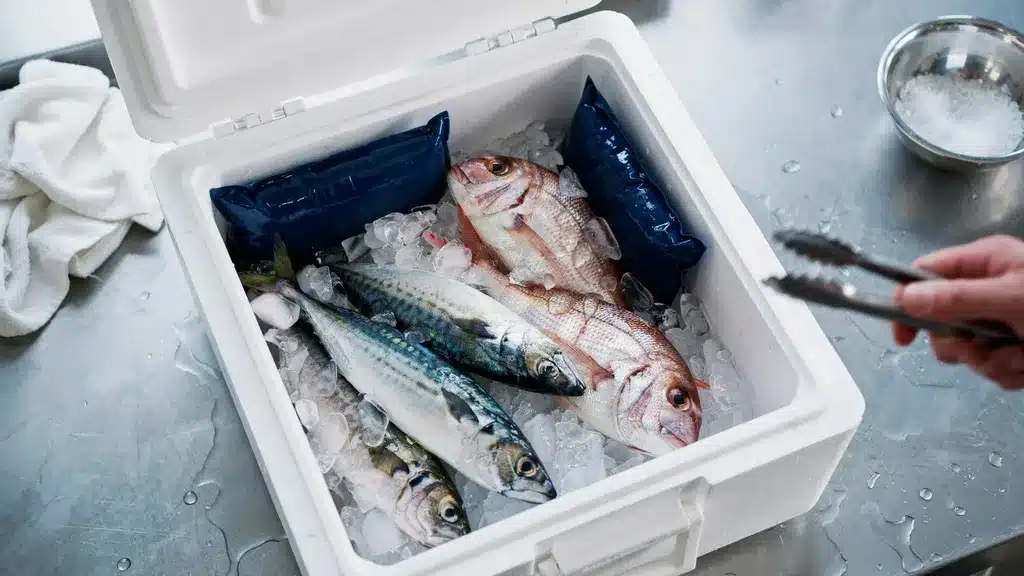
- An insulated foam cooler that fits inside a corrugated outer box — the two-layer system is what holds temperature.
- The right coolant: dry ice for frozen (keeps -4°F for 24-48 hrs), gel packs or wet ice for fresh. Never let wet ice melt onto live shellfish.
- Vacuum-sealed bags and leak-proof liners so nothing drips, plus absorbent padding.
- Dry-ice handling and labels — gloves, a hazmat declaration, and the required markings. See ParcelPath’s guidance on handling regulated and fragile contents.
- A fast service and an early-week ship date.
How do you pack seafood so it arrives cold and safe?
Seafood fails from temperature and time, not impact — and a leak can ruin the box and everything near it. Pack the cold chain tight and ship fast.
- Chill or freeze first. Frozen fish should be solid at -4°F before packing; fresh seafood should be ice-cold. Vacuum-seal portions.
- Line and seal against leaks. Put product in leak-proof bags and line the cooler so no liquid escapes — a melting-ice leak is the most common failure.
- Add the right coolant. Dry ice on top of frozen product (cold sinks); gel packs around fresh product. For live lobster, use damp newspaper or seaweed and gel packs — never submerge or freeze them.
- Box the cooler. Place the foam cooler inside a sturdy corrugated box and fill gaps so nothing shifts.
- Declare, label, and ship overnight. Mark and declare dry ice as required, label “Perishable — Keep Refrigerated,” and ship overnight or 2-day, early in the week.
How do you ship seafood with ParcelPath, step by step?
- Create your free ParcelPath account. No monthly fee; save your details once.
- Enter the package details. Destination ZIP, total packed weight (coolant adds weight), dimensions, and flag dry ice.
- Compare fast discounted rates. Choose overnight or 2-day — the discount makes the fast service affordable.
- Pay and print. Pay only for the label — no platform fee — and print at home.
- Ship early in the week so the cold chain isn’t tested over a weekend.
How much does it cost to ship seafood?

Shipping seafood runs a wide range for most orders in 2026, driven by weight, distance, coolant, and the fast service it requires. Overnight delivery and dry ice add cost, but they’re non-negotiable — and ParcelPath’s discounted rates are what keep an overnight seafood box affordable rather than prohibitive.
The single rule that beats every other: ship fast, early in the week. No amount of dry ice saves a seafood box that sits in a sortation hub over the weekend.
Frozen, fresh, or live — what changes?
| Type | Coolant | Key rule |
|---|---|---|
| Frozen fish & shrimp | Dry ice | Keep at -4°F; declare and label the dry ice |
| Fresh fillets | Gel packs / wet ice | Keep ice-cold, leak-proof, ship overnight |
| Live lobster & shellfish | Gel packs + damp packing | Need air; never submerge or freeze |
| A whole catch (e.g., Alaska) | Dry ice, frozen solid | Freeze hard, overnight air, early in week |
What goes wrong when shipping seafood — and how do you avoid it?
- Slow service. The cold chain fails over time. Ship overnight or 2-day, early in the week.
- Leaks. Melting ice ruins the box. Use leak-proof bags and liners.
- Wrong coolant. Wet ice on frozen fish thaws it; dry ice on live lobster kills it. Match coolant to product.
- Undeclared dry ice. It’s hazmat — declare and label it or the package is rejected.
- Paying retail. Overnight at the counter is brutal. ParcelPath’s 60-89% discount makes it work.
Ship your seafood for less
Create a free ParcelPath account, compare discounted overnight UPS and USPS rates, and print your label in minutes — no monthly fee, no minimums.
Get discounted shipping ratesFAQ: How to Ship Seafood
How do you ship seafood so it stays fresh?
Pack it cold in an insulated foam cooler inside a sturdy box — dry ice for frozen, gel packs or wet ice for fresh — with leak-proof liners, then ship overnight or 2-day, early in the week. Speed and an unbroken cold chain are everything.
How much does it cost to ship seafood?
Most seafood ships at up to 89% off retail through ParcelPath’s discounted rates, depending on weight, distance, coolant, and the fast service required. Overnight and dry ice add cost, but the discount keeps it affordable.
Can I ship seafood with dry ice?
Yes, for frozen seafood — dry ice holds -4°F for 24-48 hours. It’s a regulated hazardous material, so you must declare it, label the package, stay within the carrier’s limit, and never seal it airtight (it must vent).
How do you ship live lobster?
Pack live lobster with damp newspaper or seaweed and gel packs in an insulated box so they stay cool and moist with air — never submerge or freeze them — and ship overnight only.
What temperature should frozen seafood stay at in transit?
-4°F (-20°C) or below. Freeze the product solid first and use dry ice to maintain that temperature through overnight delivery.
Is ParcelPath really free to use?
Yes. No monthly fee, no subscription, no minimums. You pay only for postage and get UPS and USPS rates 60-89% below retail.
What’s the best day to ship seafood?
Monday or Tuesday with overnight or 2-day service, so the box doesn’t sit in a sortation hub over the weekend and break the cold chain.
Do I need a printer to ship seafood with ParcelPath?
No. Print at home, or use a UPS mobile barcode or USPS Label Broker code to print free at a counter.
Methodology & sources: Cold-chain methods, dry-ice handling, temperature targets, and cost ranges are drawn from ParcelPath’s perishable-shipping guides and published seafood-shipping practice. Primary references: Upper — How to Ship Fresh Seafood (2026), Global Seafoods — Shipping Frozen Seafood, FishEx — Seafood Shipping & Packaging, SoPo Seafood — Shipping Seafood Overnight, and MGS IceStorm — How to Ship Seafood Safely. No reader anecdotes were used; figures trace to platform and industry sources.


