
Table of Contents
- Key Takeaways
- What is ParcelPath, and why use it to ship car parts?
- What car part are you shipping, and where do you start?
- What do you need before shipping a car part?
- How do you pack a car part so it arrives undamaged?
- How do you ship car parts with ParcelPath, step by step?
- How much does it cost to ship car parts?
- Ground or LTL freight — which should you use?
- What goes wrong when shipping car parts — and how do you avoid it?
- Ship your car parts for less
- FAQ: How to Ship Car Parts
How do you ship car parts? Send small parts (5-75 lb) by discounted UPS or USPS ground, and crate heavy parts like engines and transmissions for LTL freight — drain all fluids first, then use ParcelPath to compare rates 60-89% off retail. Costs run higher for freight than for small parts.
Key Takeaways
- ParcelPath is free to use — no monthly fee, no minimums — and passes commercial UPS and USPS rates 60-89% below retail.
- Small parts (5-75 lb) ship ground — faster and cheaper than freight for alternators, bumpers, and tires.
- Heavy parts go LTL freight. An engine or transmission (100-300 lb) must be crated or palletized; a transmission typically ships as crated LTL freight.
- Drain all fluids first — oil, coolant, and fuel are hazards and most carriers require it before shipping engines and transmissions.
- Keep ground parcels under 150 lb and within size limits to avoid oversize surcharges; above that, freight is the route.
- The ParcelPath flow is three actions: enter package details → compare rates & print → drop off or schedule pickup.
What is ParcelPath, and why use it to ship car parts?
ParcelPath is a free shipping platform that gives individuals and small businesses access to commercial UPS and USPS rates — the same 60-89%-off pricing high-volume shippers get — with no monthly fees or minimums. You pay only for the postage you actually buy.
Auto parts are heavy and oddly shaped, which is exactly the profile carriers surcharge hardest at the counter. Because ParcelPath lets you compare discounted UPS and USPS rates side by side, you route each part to the cheapest service for its weight and zone — and for the big stuff, you can compare against LTL freight so you are never overpaying for ground on a part that belongs on a pallet.
You also create and print the shipping label at home and drop off at any UPS or USPS location or schedule a pickup.
What car part are you shipping, and where do you start?
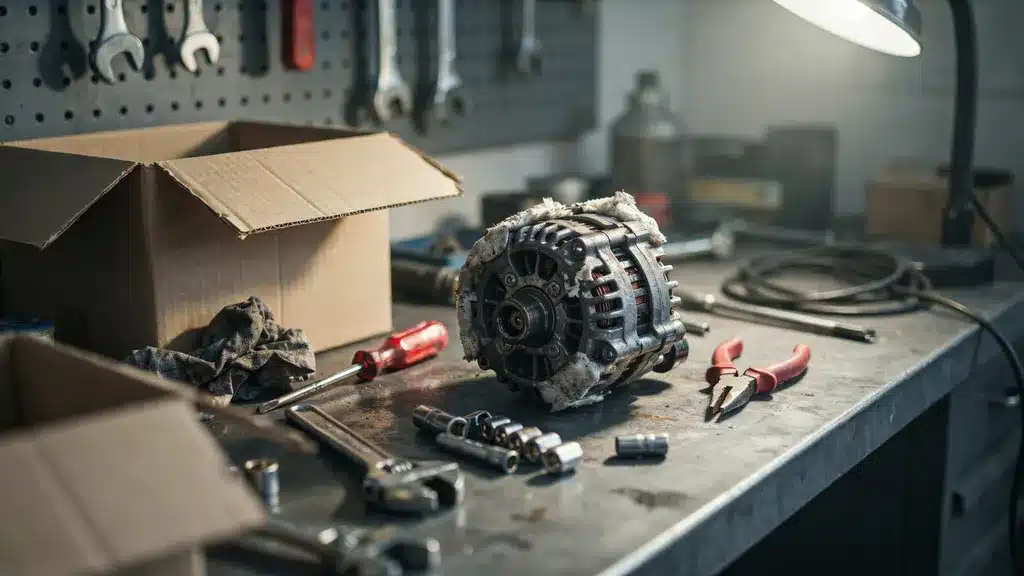
The method is set by weight and size: small parts ship as ground parcels, heavy parts ship as freight. The table shows the route and ParcelPath cost range for each, with step-by-step guides. Start with what you are sending.
| Part | How to ship it | Cost |
|---|---|---|
| Bumper | Large box, ground (light but bulky) | See your rate |
| Car hood | Crated or LTL freight (large, dent-prone) | See your rate |
| Tires & wheels and tires | Ground per tire, or palletized in bulk | See your rate |
| Generator | Box or pallet by weight; drain fuel | See your rate |
| Transmission | Crated/palletized LTL freight; drain fluids | See your rate |
| Engine | Crated LTL freight; drain all fluids | See your rate |
| Motorcycle | Crated freight or specialty transport | See your rate |
Costs swing widely with weight, dimensions, and distance — run your numbers through the ParcelPath shipping calculator for an exact ground quote before you buy.
What do you need before shipping a car part?
- The part’s real weight and dimensions. This single fact decides ground vs. freight and prevents reweigh adjustments.
- A heavy-duty double-wall box for ground parts, or a wooden crate or pallet for heavy parts going freight.
- Drained fluids and a clean part. Oil, coolant, and fuel must be emptied from engines, transmissions, and generators before shipping.
- Heavy cushioning and strapping — greasy metal parts shift and puncture boxes. See ParcelPath’s guidance on shipping large and heavy items.
- The destination address and declared value for expensive components.
How do you pack a car part so it arrives undamaged?

Heavy metal parts are unforgiving: they shift, leak, and tear through weak packaging. Pack for the weight, and remember about 1 in 10 parcels arrives damaged — for auto parts it is almost always inadequate packaging that causes it.
- Drain and clean. Empty all oil, coolant, and fuel from engines, transmissions, and generators. Residual fluid is a safety hazard and a claim-killer.
- Protect machined surfaces. Wrap threads, flanges, and sealing surfaces; cap open ports so dirt and damage stay out.
- Choose box or crate. Parts under ~75 lb go in a heavy-duty double-wall box; engines, transmissions, hoods, and motorcycles get a wooden crate or pallet for LTL freight.
- Immobilize and cushion. Strap the part so it cannot shift, and fill every void with dense foam — a part that moves is a part that breaks the box.
- Seal, label, and (for freight) palletize. Tape ground boxes with the H-taping method; band crated parts to a pallet and attach the freight label.
How do you ship car parts with ParcelPath, step by step?
- Create your free ParcelPath account. No monthly fee; save your details once.
- Enter the package details. Destination ZIP, the part’s weight, and box or crate dimensions — accuracy here decides the route and the rate.
- Compare discounted rates. For parts under ~75 lb, compare UPS and USPS ground; for heavy parts, compare LTL freight options.
- Add declared value and pay. Insure expensive components, then pay only for that label.
- Print and ship. Print at home or use a mobile barcode, then drop off (ground) or schedule a freight pickup.
How much does it cost to ship car parts?

Shipping car parts ranges from a modest cost for a single tire up to a much higher cost for a crated engine. Small parts under 75 lb ship as ground parcels, while large or heavy parts ship LTL freight, where a transmission’s cost scales with weight and distance.
The biggest money mistake is shipping a heavy part the wrong way — ground on something that belongs on a pallet racks up oversize and overweight surcharges, while paying freight minimums on a 40-lb part wastes money. Compare both in ParcelPath and let the weight decide.
Ground or LTL freight — which should you use?
| Part profile | Best method | Why |
|---|---|---|
| Under ~75 lb (alternators, bumpers, single tires) | UPS / USPS Ground | Faster and cheaper than freight; no pallet needed |
| Bulky but light (hoods, body panels) | Crated freight | Large dimensions trigger oversize fees on ground |
| Heavy (engines, transmissions, 100 lb+) | LTL freight, crated | Over ground limits; needs palletizing and a liftgate |
| Bulk tires/wheels (sets) | Palletized freight | Cheaper per unit than individual ground labels |
What goes wrong when shipping car parts — and how do you avoid it?
- Shipping heavy parts as ground. Oversize and overweight surcharges pile up. Crate and ship freight above ~75-150 lb.
- Leaving fluids in. A safety hazard and an automatic claim denial. Drain everything.
- Weak boxes. Greasy metal tears through single-wall cardboard. Use double-wall boxes or crates.
- Parts that shift. Unstrapped parts break the box and themselves. Immobilize and fill voids.
- Paying retail. Walking into a carrier counter forfeits the 60-89% discount. Create the label through ParcelPath instead.
Ship your car parts for less
Create a free ParcelPath account, compare discounted ground and freight rates, and print your label in minutes — no monthly fee, no minimums.
Get discounted shipping ratesCan You Ship Car Parts Overnight?
Yes. UPS Next Day Air and USPS Priority Mail Express are the two common ways to get a car part to a shop by the next business day, or within two days for Priority Mail Express to some ZIP codes. Overnight costs much more than Ground, so use it when a vehicle is out of service while it waits for the part.
- Weight limits: Priority Mail Express accepts packages up to 70 pounds, and UPS Next Day Air goes up to 150 pounds. Heavy parts like transmissions or cylinder heads usually have to go by air with UPS.
- Cutoff times: drop off or schedule a pickup before the carrier’s daily cutoff, or the next-day clock starts a day later. For a Monday arrival, look at Saturday delivery options.
- Air restrictions: airbag inflators, lead-acid batteries, and parts with fuel or oil residue fall under hazardous materials rules and generally can’t go in a standard overnight air box. Drain and clean fluid-bearing parts, and check the carrier’s hazmat guidance first.
- Dimensional weight: bumpers and body panels are billed by size, so overnight shipping for them gets expensive.
When the destination is in a nearby zone, UPS Ground often arrives in one or two days anyway. Compare its transit estimate before you pay for air.
FAQ: How to Ship Car Parts
How much does it cost to ship car parts?
Small parts under 75 lb ship ground at up to 89% off retail through ParcelPath’s discounted rates; heavy parts ship LTL freight, where a transmission and an engine both ship as crated LTL freight priced by weight and distance.
What is the cheapest way to ship car parts?
For parts under about 75 lb, discounted UPS or USPS ground is cheapest — compare both in ParcelPath. For heavy parts, palletized LTL freight is the value route; shipping a heavy part by ground racks up oversize surcharges.
How do I ship an engine or transmission?
Drain all fluids, protect machined surfaces, and crate the part on a pallet — LTL carriers generally require engines to be fully crated. Then compare LTL freight options in ParcelPath. Expect pricing that scales with weight and distance.
Do I have to drain fluids before shipping auto parts?
Yes. Oil, coolant, and fuel must be drained from engines, transmissions, and generators. Carriers can reject undrained parts, and residual fluid voids most damage claims.
Can I ship car parts with UPS or USPS?
Yes, for parts within ground limits — UPS Ground handles parcels up to 150 lb. Above that, or for very large parts, use LTL freight. ParcelPath shows discounted rates so you pick the cheapest route per part.
How do I ship tires?
Single tires ship affordably by ground; for sets or wheels-and-tires, palletized freight is usually cheaper per unit than individual ground labels. Compare both in ParcelPath.
Is ParcelPath really free to use?
Yes. No monthly fee, no subscription, no minimums. You pay only for postage and get UPS and USPS rates 60-89% below retail.
Do I need a printer to ship car parts with ParcelPath?
No. Print the label at home, or use a UPS mobile barcode or USPS Label Broker code to print free at a counter.
Methodology & sources: Ground-vs-freight thresholds, fluid-draining and crating requirements, and cost ranges are drawn from ParcelPath’s auto-parts guides and published freight practice. Primary references: Freightquote — Shipping Auto Parts Guide, FedEx — How to Ship Automotive Parts, TSI Shipping — How to Ship Engines & Transmissions, uShip — Cost to Ship a Transmission, and eFulfillment — Cheapest Ways to Ship Auto Parts. No reader anecdotes were used; figures trace to carrier and platform sources.
Part of our Shipping Guides hub.
In this section:
- How to Ship a Generator
- How to Ship a Car Hood
- How to Ship a Bumper
- Best Way to Ship Wheels and Tires
- How to Ship a Motorcycle
- How to Ship an Engine
- How to Ship a Transmission
- How to Ship Tires
- How to Ship Car Seats
- Send Used Tires
- Ship Tires Cheap
- Ship Wheels


