
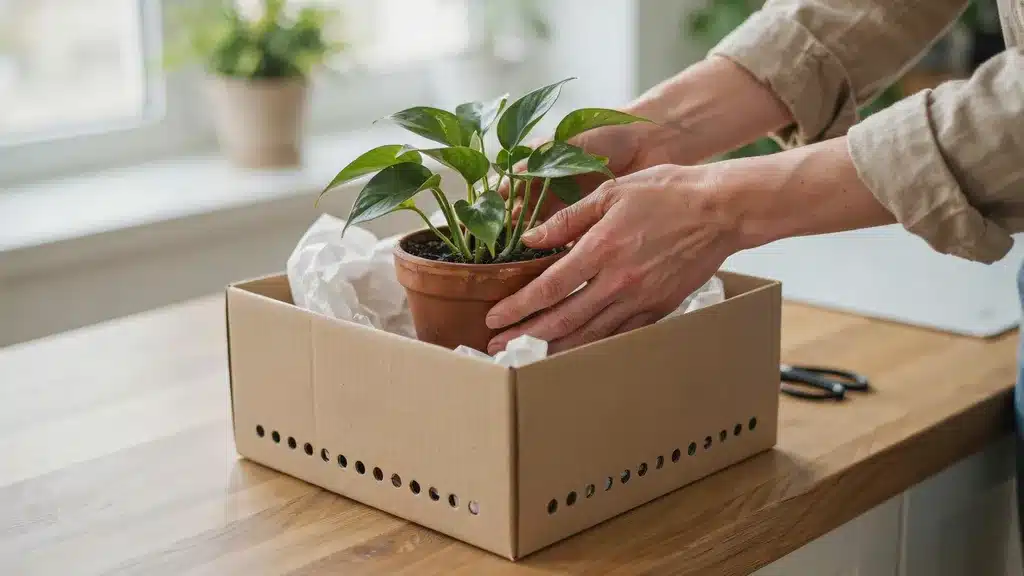
To ship plants, let the soil dry for several days, seal the soil surface and root ball in plastic wrap, wrap the foliage loosely in paper, and pack the pot so it cannot move inside a snug, sturdy box. Then ship with a 2–3 day service (or faster) early in the week, so the plant spends as little time in the dark as possible and never sits in a hub over a weekend.
Live plants are mailable within the United States, but they are subject to federal and state agricultural rules, and USPS spells out how roots and packing material must be wrapped. This guide covers the rules, the packing method for potted plants, bare-root plants and cuttings, the fastest sensible carrier services, and how to handle hot and cold weather.
Can you legally ship live plants?
Yes. USPS Publication 52 states that plants and plant products are mailable within the United States, its territories and possessions, but subject to prohibitions and restrictions imposed by federal agricultural and conservation laws. A plant becomes nonmailable when one of those rules makes the shipment unlawful.
The rule that catches most home shippers is quarantine. Under USDA plant quarantines, any plant or plant product that can carry a dangerous plant disease or insect infestation cannot be mailed out of a quarantined area unless it has been inspected and cleared. Quarantines cover different pests in different parts of the country, and Hawaii, Puerto Rico and the U.S. Virgin Islands have their own.
- Check the destination state. Several states, especially agricultural states and Hawaii, restrict or inspect incoming plants, soil and certain species. Look up the state department of agriculture rules before you ship.
- Check endangered species rules. UPS will not accept any plant or animal listed as an endangered species, and federal conservation law applies on every carrier.
- Selling plants? Commercial nurseries and online plant sellers usually need a state nursery license or phytosanitary inspection. Hobby swaps between friends rarely do, but quarantine rules still apply.
International plant shipments are a different matter: most countries require an import permit and a phytosanitary certificate, so this guide focuses on domestic shipping.
What do you need to pack a plant?
- A sturdy corrugated box only a little larger than the plant and its padding. Too big and the plant tumbles; too small and the leaves are crushed.
- Waterproof wrap for the roots. USPS lists plastic wrap, kraft paper waxed on one side, kraft paper with a waxed or tarred liner, and tar-centered paper as acceptable materials.
- Rubber bands or tape to hold the wrap around the soil or root ball.
- Newspaper, tissue or a paper plant sleeve to protect the foliage, plus crumpled paper to fill empty space.
- Damp sphagnum moss or paper towel for bare roots and cuttings.
- A plant heat pack or cold pack for extreme weather (see below).
- A label printer or a printer-free option. The guide to the best labels and printers for shipping covers home setups.
Plants rarely break the way glassware does, but the cushioning logic is the same: nothing should be able to move. The guide to shipping fragile items and valuables explains box-in-box packing if you are sending a ceramic or glazed pot.
How do you pack a potted plant for shipping?
- Stop watering a few days ahead. Slightly dry soil is lighter, does not leak through the box, and lowers the risk of rot in a dark, warm box. Succulents and cacti can go a week or more without water before shipping.
- Seal the soil. Cover the soil surface with plastic wrap and secure it around the pot rim with a rubber band or tape, so soil stays in the pot even if the box is turned on its side.
- Protect the foliage. Slide a paper sleeve over the plant or loosely roll it in newspaper. Tie up long stems or vines gently. For plants with thorns or spines, USPS requires the covering to be puncture-proof.
- Brace the pot in the box. Wedge crumpled paper around the pot until it cannot shift, and add a cardboard collar around the stem area so the top of the plant is held away from the box walls.
- Seal, mark and label. Tape all seams, mark the box “Live Plants” and “This Side Up”, and attach the label on the top panel.
For larger plants or heavy ceramic pots, consider shipping the plant bare-root (below) and the pot separately. It is lighter, it removes the most likely source of breakage, and the soil can be replaced at the destination.
How do you ship bare-root plants and cuttings?
Bare-root shipping is how most nurseries send perennials, roses, trees and succulents, because it removes the weight and mess of soil. Shake or rinse the soil off the roots, then wrap them in damp (not wet) sphagnum moss or paper towel. Enclose the roots in plastic wrap or a plastic bag tied around the base of the stems.
USPS requires roots, butts of plants and any wettable packing material to be wrapped or boxed in waterproof material that keeps the roots moist without weakening the box and without leaking during handling. The tops of plant bundles need a protective covering of paper, straw or similar material so the plant is not injured or dried out.
Cuttings are the most delicate shipment of all, because they have no roots to draw water. Wrap the cut ends in damp paper towel inside a small plastic bag, lay the cuttings flat in a small box or padded mailer so they cannot bend, and use the fastest service available. Succulent cuttings are the exception: let the cut ends callus for a few days and ship them dry, wrapped in paper.
Which shipping service is best for live plants?
Speed matters more for plants than for almost anything else you can ship. A healthy plant will usually tolerate several days in a box, but every extra day in the dark costs it vigor, so a 2–3 day service or faster is the safest choice and ground service is only for hardy plants on short routes.
| Service | Published delivery time | Weight limit | Best for |
|---|---|---|---|
| USPS Priority Mail Express | 1–3 days, money-back guarantee | 70 lb | Cuttings, cut flowers, delicate tropicals |
| USPS Priority Mail | 2–3 days | 70 lb | Most small and medium potted plants |
| USPS Ground Advantage | 2–5 days | 70 lb | Hardy, dormant or bare-root plants on short routes |
| UPS 2nd Day Air / 3 Day Select | 2 or 3 business days | 150 lb | Larger or heavier plants needing speed |
| UPS Ground | 1–5 business days | 150 lb | Heavy, hardy plants on nearby routes |
Two other details shape the choice. First, box size: once a USPS package is larger than one cubic foot (1,728 cubic inches), it is billed by dimensional weight, so a plant box should be as small as safe packing allows. Second, the day of the week: ship Monday through Wednesday so a 2–3 day shipment arrives before the weekend.
The price depends on weight, box size, distance and speed, so the quickest way to choose is to compare the services side by side. With ParcelPath you can compare live UPS and USPS rates for your plant box in the ParcelPath rate calculator; it is free to use, with no subscription or per-label fee, and offers up to 89% off USPS and up to 85% off UPS retail rates. The ParcelPath shipping calculator guide explains how weight, size and zone feed into the price.
How do you ship plants in hot or cold weather?
| Condition | What to do | Why |
|---|---|---|
| Freezing temperatures on the route | Add a plant heat pack, line the box with insulation, and use the fastest service | A few hours below freezing can kill tropical plants and damage leaves |
| Summer heat | Ship early in the week, use a 1–2 day service, avoid black or plastic outer bags | Trucks and parked vehicles get very hot and cook foliage |
| Cuttings | Damp wrap on the cut ends, small box, fastest service | Unrooted cuttings dry out quickly |
| Dormant plants | Ship bare-root in late winter or early spring | Dormant plants tolerate transit far better than ones in active growth |
Place a heat pack against the side of the box, never touching the leaves, and match its rated duration to the expected transit time. Tell the recipient that a plant is on its way, so it is brought inside and unboxed the day it arrives rather than left on a porch.
How do you ship plants with ParcelPath?
- Weigh and measure the packed box. Use whole inches and round the weight up to the next pound.
- Enter the details. Add the destination address, weight and dimensions, and compare the USPS and UPS services that fit your timeline.
- Buy and print the label. No printer? Use a UPS Mobile Barcode at a UPS Store or a USPS Label Broker code at the Post Office, and the label is printed for you.
- Hand it off early in the week. Drop the box at a Post Office or UPS location, or schedule a free USPS pickup from your door.
- Add coverage for valuable plants. Priority Mail and Ground Advantage include up to $100 of insurance, and ParcelPath offers Shipsurance for rare or high-value specimens.
If you sell plants online, build shipping into your prices from the start. The guide to product pricing with a shipping calculator shows how to set prices that cover your packaging and postage.
What goes wrong when shipping plants?
- Wet soil. It leaks through the box, adds weight and invites rot. Water a few days before, not the morning you ship.
- A pot that can move. It tips, spills soil and strips leaves. Seal the soil and brace the pot.
- A slow service or a weekend in transit. Choose a 2–3 day service or faster and ship early in the week.
- Ignoring the weather. Heat and frost kill more shipped plants than rough handling does.
- Skipping the rules. Plants from a quarantined area, or species a destination state restricts, can be refused or destroyed.
Frequently Asked Questions
Can you mail live plants through USPS?
Yes. USPS Publication 52 says plants and plant products are mailable within the United States and its territories, subject to federal agricultural and conservation rules. Plants from areas under a USDA quarantine can only be mailed after inspection, and some states restrict particular species, so check the destination state’s rules before you ship a live plant.
How long can a plant survive in a shipping box?
Most healthy, well-packed plants tolerate several days in a box, and dormant bare-root plants tolerate more. Cuttings and actively growing tropicals decline fastest. That is why a 2–3 day service such as USPS Priority Mail is the safest choice, shipped early in the week so the plant never waits in a facility over a weekend.
Should you water a plant before shipping it?
Water it a few days before shipping, not on the day. Slightly dry soil is lighter, will not leak through the box, and reduces rot in a dark, warm package. Bare roots and cuttings are different: wrap them in damp sphagnum moss or paper towel, then seal them in plastic so the moisture stays with the roots.
What is the best way to ship plants in winter?
Add a plant heat pack rated for longer than the expected transit time, line the box with insulation, and choose a fast service such as Priority Mail or UPS 2nd Day Air. Keep the heat pack away from the leaves, ship early in the week, and ask the recipient to bring the box inside as soon as it arrives.
Do you need a permit to ship plants to another state?
For a personal shipment of common houseplants between most states, no permit is usually needed. Permits or inspections apply when the plant comes from a USDA quarantine area, when the destination state restricts that species or soil, or when you sell plants commercially, which often requires a state nursery license or phytosanitary certificate.
Sources
- USPS Publication 52, 561: Plants (general mailability)
- USPS Publication 52, 562: Plant quarantines
- USPS Publication 52, 563: Packaging and marking plants
- USPS: Priority Mail
- USPS: Ground Advantage
- UPS: How to Ship Plants and Live Animals
For more plant and packing tips, follow ParcelPath on Instagram.
Part of our Shipping Guides hub.
In this section:
- How to Ship a Bonsai Tree
- How to Ship a Jade Plant
- How to Ship Succulents
- How to Ship Fresh Flowers
- How to Ship Plant Cuttings
- Best Way to Mail Plants
- Send a Plant in the Mail


